Investing in a sustainable future
1. A truly sustainable transportation solution
The Alto project represents a concrete response to climate challenges. By providing a low-carbon transportation option, it contributes directly to Canada’s aim of becoming carbon neutral by 2050. Across its life cycle, the network powered by clean electricity will significantly reduce greenhouse gas emissions in the transportation sector, a significant step toward a more sustainable future.
In addition to encouraging more people to use high-speed rail for travel, Alto will incite intercity travellers to use an efficient and sustainable mode of transportation rather than travel by car or plane. This transition will help prevent many short-haul flights and remove the carbon emissions equivalent of 100,000 cars from the road each year. Powered by low‑emission electric energy, Alto will be a high‑performance and environmentally responsible solution.
At each stage, we are committed to minimizing the project’s environmental footprint. The design is based on rigorous scientific data, the results of public consultations and Indigenous knowledge. Mitigation and compensation measures will be implemented to protect natural environments and communities near the route.
The project is subject to the Impact Assessment Act of Canada, ensuring a transparent process that conforms to laws and regulations, in consultation with local stakeholders.
2. Field studies: Understanding and protecting
In order to preserve natural environments and the well-being of communities, Alto relies on in-depth knowledge of the land to build a network of nearly 1,000 km. Our specialists conduct field studies along the study corridor to better understand natural environments, wildlife, water bodies, soil and air quality.
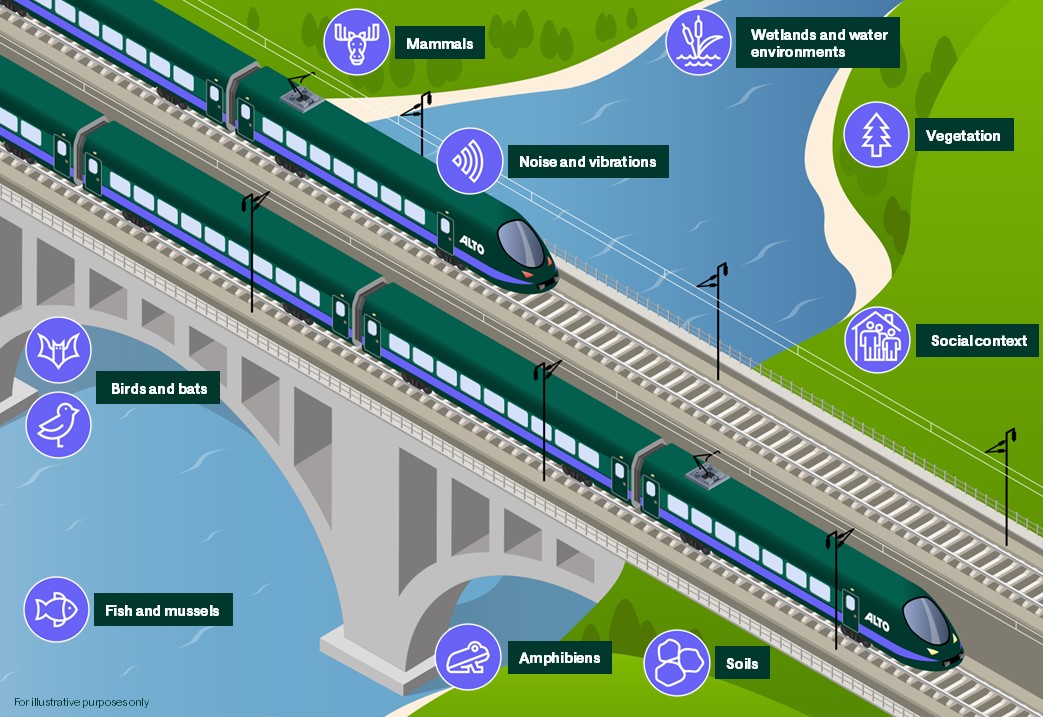
These studies are essential to:
- Establish baseline environmental conditions prior to construction
- Assess the impact of the project on community health and ecosystems
- Define protection, mitigation and compensation measures
The analyses cover a wide range: noise and vibration, soil, wetlands and water environments, fish habitat, mammals and plant species, amphibians, birds, social context and more. The data are collected by biologists, engineers and experts using methods consistent with provincial and federal guidelines.
A transparent and respectful approach
Guided by respect and transparency, Alto is working with communities and landowners to obtain access to specific properties in the study corridor. Each authorization request is preceded by clear communication to agree on the terms and conditions of access. Services are in place to support landowners, answer their questions, and ensure that everything is carried out in the best possible conditions. Our experts will then be able to go out and perform the necessary surveys.
The results of the studies will be made available to the public in accordance with privacy laws.
3. Indigenous participation in field and archaeological studies
Participation of Indigenous communities is of paramount importance to Alto. Their contribution to field and archaeological studies contributes to a better understanding of ecosystems and protects cultural heritage.
A collaborative approach based on:
- Integration of Indigenous knowledge into environmental analysis
- Joint identification of mitigation measures to preserve the environment and cultural sites
- Respect for Indigenous protocols in the event of the discovery of archaeological remains
These studies are a key step toward obtaining construction permits. Alto works with communities to ensure that their priorities are considered and their voices heard throughout the project.
We are committed to maintaining this respectful and sustainable approach to build a network that honours the knowledge, cultures, and aspirations of Indigenous peoples—today and for generations to come.

Navigation

Share your thoughts with us


Learn more about the key themes of the project



Important Links
Alto Website

Stay up to date with everything that’s going on.
FAQs
-
 THE PROJECT
-
SEGMENTED APPROACH
- 6. What are the benefits of a segmented approach for Canadians?
- 7. Why was Ottawa–Montréal chosen as the first segment for Alto?
- 8. When will construction begin on the segment between Ottawa and Montréal, and what will the alignment be?
- 9. When will the first segment between Ottawa and Montréal become operational?
- 10. When can we expect construction to begin on the other segments?
- 11. Are there any plans for expansion, e.g., to Windsor or elsewhere in Québec?
-
DEVELOPMENT AND CONSTRUCTION
- 12. Is a high-speed rail network safe for passengers and the communities it passes through?
- 13. Is the technology of the high-speed rail network appropriate and safe for extreme climates, including harsh Canadian winters?
- 14. Why can’t you use the existing CN and CP railway corridors?
- 15. How will it be possible to cross from one side of the railway to the other without level crossings?
- 16. How much land will need to be purchased? Will the project result in expropriations?
- 17. How can I offer my professional products or services to Alto?
-
ENVIRONMENT
-
CONSULTATIONS AND INDIGENOUS RELATIONS
-
SPIN-OFFS AND BENEFITS
-
ENQUIRIES

